
Add products by adding codes
Add a CSV file
Enter the product codes that you want to add to the cart in bulk (after a comma, with a space or from a new line).
Repeating the code many times will add this item as many times as it appears.
DC 3V-6V class 140 2000RPM brush motor
Product code: 7681
- Class 140 miniature DC motor. Ideal as a drive for various mechanical structures, RC models and robots. It will certainly find its use in Arduino projects as well.
DC 3V-6V class 140 2000RPM brush motor
$0.69
DC 3V-6V motor - DC brush motor
Description
Class 140 miniature DC motor. Ideal as a drive for various mechanical structures, RC models and robots. It will certainly find its use in Arduino projects as well.
Product features
- DC brush motor for small mechanical devices and robots
- Standard size DC motor type 140
- These motors operate over a supply voltage range of 3V to 5V
- This range makes them ideal for control via Arduino chips powered by a low voltage of 5V
- Thanks to its low current consumption, this motor can be powered from the same source as the control electronics.
- A DC motor controller can also be used to control these motors - Controller module L298N
Technical data
- Length: 25mm
- Diameter: 21mm
- Shaft diameter: 2mm
- Shaft length: 9mm
- Voltage: 3-5 V
DC motor control with Arduino
Write your opinion
Brand
Entity responsible for this product in the EU
JH Global Trading (HK) Co., LimitedMore
ProducerJH Global Trading (HK) Co., LimitedAddress:
Room G, Floor 10, Block A, Duhui Electronic Building, Huaqiang Road 10Postal Code: CN 518031City: ShenzhenCountry: ChinaPhone number: 86 075582557429E-mail: info@jh-electronica.com
Responsible entityABC-RC Firma LedaAddress:
Judy Tadeusza 9Postal Code: 34-122City: NidekCountry: PolandPhone number: 333-003-080E-mail: pomoc@abc-rc.pl
Symbol
7681
Producer code
5904384704798
Brand
Inna
Status
New
Symbol
DC140
Manufacturer
unbranded
Manufacturer code
7681
Ask for this product
Guide


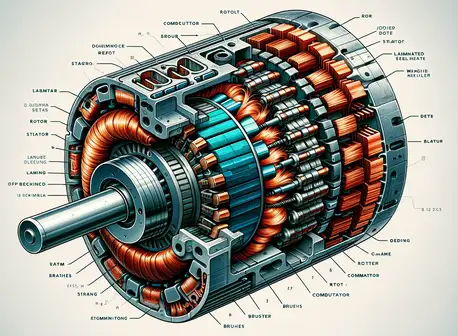
Brush Motor Construction - Everything you need to know about it
Brush motors, also called commutators, they have changed technology since their inception in the 19th century. With their simple design and reliability, they have mastered many fields. They concern both the automotive industry and equipment for the home.
Understanding how they work and how they are built is important for engineers, technicians and even hobbyists. In this text you will learn more about their construction, operation, applications, as well as advantages and disadvantages.